|
|
I thoroughly researched how to waterproof concrete throughout 2012. Since then I have been very public criticising admixture manufacturers for not being as honest as they make out. I could be out of date now, but no one has contacted me in any way to say that they have improved anything - so I don't expect that I am out of date. In particular, as far back as 2013, I was pointing out how BBA certificates for concrete waterproof admixtures were pulling the wool over your eyes. During the enquiries into the Grenfell Tower fire, we learned that manufacturers set up their own tests for BBA certification and were able to pull the wool over the eyes of inspectors - cheat. What I see as scandals of BBA certification. There are a few factual sources. However three stand out.
The book by Neville can be found in Kingston University Library and no doubt other university libraries where they teach construction. What these quotes from the Society's paper lead me to conclude is that the BBA, the organisation most trusted by architects and engineers to test products they might specify in construction, is guilty of bias, coercion and falsehoods. That the organisation in question falsely certified a product that became the most expensive of its type and market leader. In addition, the Society's paper quotes another research paper with unequivocal evidence that one of the products with a BBA certificate does not work, does nothing, in the situation for which it is certified. In the situation for which it became market leader and the most expensive. I discuss those products that are referred to by the Society as Water-resisting admixtures for concrete. Their purpose is to reduce the amount of water that might get through a concrete structure that needs to resist water ingress. A basement is the most obvious example. In one quotation it mentions a diaphragm wall. A diaphragm wall is a wall made in the ground by filling a series of short, deep trenches (or slots). You can see an explanation here. The reason a diaphragm wall is such a good example is that without exception the water-resisting treated concrete is against original (and therefore damp or wet) ground from the start. However all basement walls are soon backfilled on the outside with damp earth usually open to rainfall, so the same conclusion applies. It is time, in this explanation, to point out that the market leading and most expensive product is Caltite. This is produced and sold in this country by Cementaid (UK) Ltd. The full quote from the Society's paper is here but I have added colours to highlight parts. From page 26. Neville seems to have overcome his doubts as they are not mentioned in the later edition (Neville, 1995) of his textbook nor in his report to Cementaid (Neville, 1988) on tests conducted by Taywood Engineering (Price, unknown). These tests were conducted to assess the use of Caltite in concrete for enhancing the durability of precast tunnel lining segments, with a view to it being used for the channel tunnel. The Caltite concrete performed better than the control concrete in water sorptivity, ISAT, water absorption and water permeability, while the chloride penetration test was deemed to be inconclusive. Neville concluded that the results show that Caltite upgraded what was already a high-quality concrete and the question to be considered is whether such upgrading is necessary or justified, bearing in mind the additional cost of the Caltite system. He added, "For the exposure conditions encountered in the UK, the answer would depend on the consideration of the life of the structure, cost of repairs, the ease with which repairs can be affected and the economic aspects of any disruption caused by the repairs." Aldred (who was once the technical director of Cementaid) has reported the benefits of Caltite in many publications. In one such paper (Aldred, 1987) he reports that in 1984 cores were taken from several old concrete structures located in the tidal and splash zones around Australia. In one structure with 11 years exposure to marine wetting and drying, the plain concrete showed evidence of aggregate exposure and steel corrosion, while the adjacent Caltite concrete (same cement content and water/cement ratio) was in excellent condition. The history and development of Caltite is also recorded by Aldred (1988). In another paper (Aldred, 2001) he concluded that the addition of Caltite in concrete with a water/cement ratio of 0.6 generally reduced water transport both when specimens were initially saturated and when specimens were initially dried. However, the use of Caltite in concrete with a water/cement ratio of 0.4 was found to reduce water transport only when the concrete was dried before testing. The fact that the relative improvement over the control concrete was greater under conditions of high water/cement ratio, limited curing and greater degree of drying led the author to suggest that the admixture tended to influence water transport through larger voids and pores, and that Caltite concrete may therefore be relatively insensitive to a certain level of site abuse. Aldred also concluded that the use of Caltite may not be effective in reducing water transport for concrete with a low water/cement ratio and no opportunity to dry before exposure, such as diaphragm walls. The diffusion of water vapour through the Caltite concrete was shown to be similar to the control concrete. In the first of these 4 paragraphs, Neville is quoted saying that Caltite upgraded an already high-quality concrete. I have presented to chartered engineers the argument that they should specify a PCE concrete instead of a proprietary brand with a BBA certificate. But they always bit back at me asking what guarantee comes with just a chemical and is it as long as the Caltite guarantee. They are misled because the Caltite guarantee, and I have copies from Cementaid dated 2005 and 2015 (one here) is limited to only what can be expected of high-quality concrete. No additional benefit of Caltite is included in the guarantee. The site filled form at the end also makes it clear that Caltite do not warrant workmanship. However, if the tunnel segments described had been oven-baked before use we think Neville would be reporting better chemical defence. This is because Caltite includes a long polymer chain in emulsion that, if dried, would set to form bitumastic-like plugs which would prevent anything getting in or through. I believe this is evidenced in the second paragraph where the concrete is sun-baked in Australia's sun. The two reports in the third paragraph are for a wet concrete (water with a mass of 0.6 the mass of the cement) and a dry concrete (water with a mass of 0.4 the mass of the cement, or only two-thirds the water in the wetter sample). We are told that the Caltite made a difference in un-dried concrete that had been a wet mix but not in the dryer mix unless it was dried first. The phrase "Caltite concrete may therefore be relatively insensitive to a certain level of site abuse", to my practised mind, could be re-written as "If the site labour add a lot of unauthorised water to the concrete, Caltite will limit the damage a bit". Please hang on to this thought till later. We will see in the Society's report what they think of these differences in concrete without Caltite. In the fourth paragraph we see the evidence that no engineer can be certain that Caltite makes a beneficial difference when used in concrete that is used beneath ground. Basements being the obvious example. The Society's paper was looking at protecting reinforcing steel in concrete from deleterious chemicals. Deleterious chemicals have to be dissolved in water as ions to attack steel. So any water-resistance equals resistance to chemicals since they are prevented by water-resistance from reaching the steel. This is referred to in the report: at page 15 first paragraph: All deterioration mechanisms in concrete rely on the presence of water to a greater or lesser extent and, with the exception of carbonation, reducing the internal moisture content will lessen the risk and/or extent of deterioration. The use of water-resisting admixtures would therefore be expected to increase durability and extend the intended working life. And again on page 36: The capillary pores are present as a result of the excess water added to the concrete to provide adequate consistence for placing but not consumed by the cement hydration. Any excess water that is not used up during cement hydration remains in capillaries running through the concrete. The less excess water used in manufacture of the concrete, the smaller and more discontinuous the capillaries in the hardened concrete, with a consequential reduction in permeability and absorption. This has resulted in water/cement ratio being used as a primary measure of water penetration and hence the durability of the concrete. (Note. Consistence used to be called workability. A layman might call a consistence runny or stiff). Page 49 mentions C35A concrete (C35 is a strength classification, the most usual strength in structural concrete, while A stands for Aqueous): The British Standard BS 8007: 1987 Design of concrete structures for retaining aqueous liquids (now withdrawn) (BSI, 1987) recommended the use of a C35A concrete, which it states will: "in general ensure that the strength, durability and impermeability will be adequate for liquid-retaining structures". From BS 8007: A pure OPC cement concrete mix should have a maximum 0.55 water to cement by mass. Therefore we can deduce that something changes in concrete between 0.60 and 0.55 water, the change being permeability. The BBA certificate for Caltite specifies that the concrete ordered for use in construction, that Caltite will be added to, must have a maximum of 0.45 (or 45%) water by mass of cement. You will recall I highlighted that Caltite made a small difference in a wet mix with water 0.60 (60%) the mass of cement but none when 0.40 was used. The BBA certificate directs that no more than 45% water is used in concrete to which Caltite is to be added. We can see that 0.45 (45%) concrete will be more water-resistant, with or without Caltite. But my issue is that the Concrete Society have spotted that the BBA used a wet concrete mix to prove that Caltite made a positive difference while certifying and specifying a far dryer mix, and we have seen the evidence that Caltite would have made no difference. THE FALSEHOOD. (See the BBA certificate on the BBA web site here, as long as it is still the 2012 version) BBA do not appear to have tested Caltite in the mix specified on their certificate. BBA has issued a certificate stating clearly for use in basements when there is academic evidence Caltite will not usually work in that environment, because basements are backfilled with soil open to rainfall and water in the surrounding ground. To me, the certificate is void and the BBA do not deserve their authority to be a testing organisation. This is the first scandal. The BBA has also produced certificates for other water-resisting admixtures approving concrete mixes with slumps that, according to the figures it publishes on these certificates, is too stiff to pump on site. I think these other certificates are void as well because they have not reported test results on concrete similar enough to what contractors will buy. I go through each of the certificates on my Other pages. But the scandal does not stop here. Page 49, which has the reference to C35A, has a lot more to say casting doubt on the benefits of any water-resisting admixture. But I accept there is nothing unlawful with selling sand to the Arabs or ice to the Eskimos. That's business. The issue that remains is whether BBA coerced the others to protect Caltite and, for the most part, I think they did. The Society created a chart on page 17 (figure 4.1) using only the data on the BBA certificates issued for 7 of the water-resisting admixtures. The worst end on their scale for permeability was set at 'typical structural concrete', concrete designed for strength without permeability in mind. Caltite is not on their chart, the Caltite figures with and without Caltite on the BBA certificate being more permeable than the typical structural concrete. On page 16: Water absorption The concretes containing water-resisting admixtures all had lower values than any of the controls. All of the values (control concretes included) were within the range for 'Low permeability' concrete (The Concrete Society, 2008). Water permeability In all cases water permeability was reduced by between 40 and 80% of the control. The results from the Caltite concrete are a different order of magnitude from the other six materials but are more representative of typical structural concrete with values in the order of 10 -12 m/s (see Figure 4.1). Other suppliers used control concretes with permeability coefficients in the range 0.003x10 -12 to 0.932x10 -12 . The least permeable control concrete used by Pudlo was less permeable than all of the concretes with water-resisting admixtures. If this is a true value it indicates that a water-resisting admixture is not necessarily required in order to achieve a concrete with 'low' permeability. Indeed, all of the control concretes with the exception of that used by Caltite appear to have out-performed normal concrete (which achieves a value of about 10 -12 m/s at water/cement ratio = 0.4) in some cases by a factor of more than 100. This casts some doubt about the absolute values reported and demonstrates the difficulty in assessing the relative performance of different materials. The Society makes it clear that all the products made the control concrete used more water resistant. The Caltite control concrete was so poor that even after being improved with Caltite it was not as good as 'typical structural concrete'. This is the evidence that the BBA test results published on the certificate bear no valid relationship to the specification on the certificate. Surely this is fraud and a criminal offence. The other 6 brands with certificates were all tested in control concrete the Society says was already better than 'typical structural concrete' yet they were all very different to each other, making comparison very difficult. One brand used control concrete considerably better than all the other treated concretes. It is my suspicion that all of the 5 brands better than Caltite but which did not use a control concrete as good as Pudlo, would have used a control concrete as good as Pudlo had they been allowed but that BBA forbid them IN ORDER TO TRY TO PROTECT CALTITE IN THE MARKET. Yet the BBA's reputation is completely solid. Architects and Engineers, as well as local authority building control officers, have been educated to accept BBA certificates without question or further research. The culture is such that if they can tick the box the product is acceptable. The culture continues to absolutely forbid any contractor using anything contrary to what is specified by the engineer. So whilst engineers have faith in BBA and specify a BBA certificated product (sometimes they add 'or similar' but this is always taken to mean 'also with a BBA certificate'), no product without a BBA certificate can be considered by any part of either the supply or delivery chains. You will be asking why doesn't someone get a BBA certificate and insist on fair testing of a PCE? PCE plasticiser will disappear within a few hours having made the concrete runny without extra water. It is not in the concrete when the concrete has hardened enough to be tested. BBA Product Certification is completely inappropriate. However testing Depth of Penetration of Water Under Pressure On Concrete to BS EN 12390-8-2009 is entirely appropriate and proves whether the concrete actually used in the structure is impermeable or not. A user of PCE plasticised, over sanded, extra cement, reduced water concrete sent us these photos of concrete from two trucks, one straight after the other. Both concretes are P360, CEM 1, max wcr 0.45 and over-sanded. However the usual dose for 6 cubic metres was added to both trucks but the first had 8 cubic metres on board and the second only 4 cubic metres, so the second photo has twice the PCE plasticiser in the first. You would think that the difference in water to cement is massive but the batcher insists both were the same. The difference shows the power of PCE plasticiser. 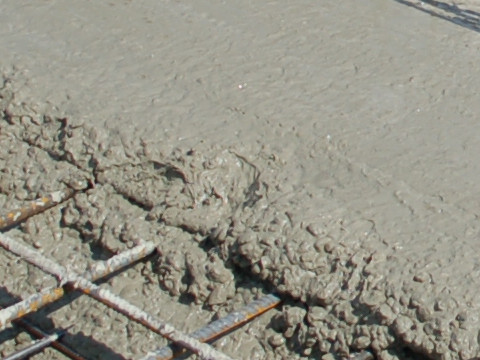
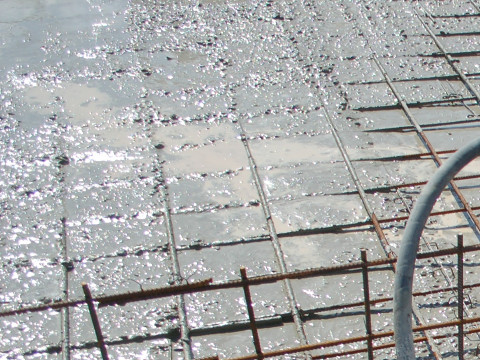
Incidentally, the manufacturer of the PCE used here recommends using much the same amount of additive as in the second photo, or even more to make concrete self-compacting, but if there is a delay between trucks slab joints can look very messy if the two batches cannot be knitted together. There is no issue that the joint might not be waterproof, that will be because the weight of the next concrete will displace enough of the laitance. But 20mm stones are not very good at pretending to be 1mm to 19mm thick if the old concrete under the new has become stiff. So most of the rest of the world is using more waterproof concrete than the UK, usually for a tiny fraction of the price we pay for Caltite and others. BBA certification has harmed our nation's competitiveness. These issues need discussing in the open, in professional magazines and at meetings of professionals.
This page opened in a new tab. Click on your previous tab to go back to the mini menu. |